Key takeaways
- How to invest in a US IPO from India: fund a US stocks account under LRS before listing day, then buy with a limit order when trading starts.
- SpaceX’s final prospectus ruled out any public offer of its shares in India, allowing only private placements.
- US retail IPO programmes such as E*TRADE’s and SoFi’s are for US residents.
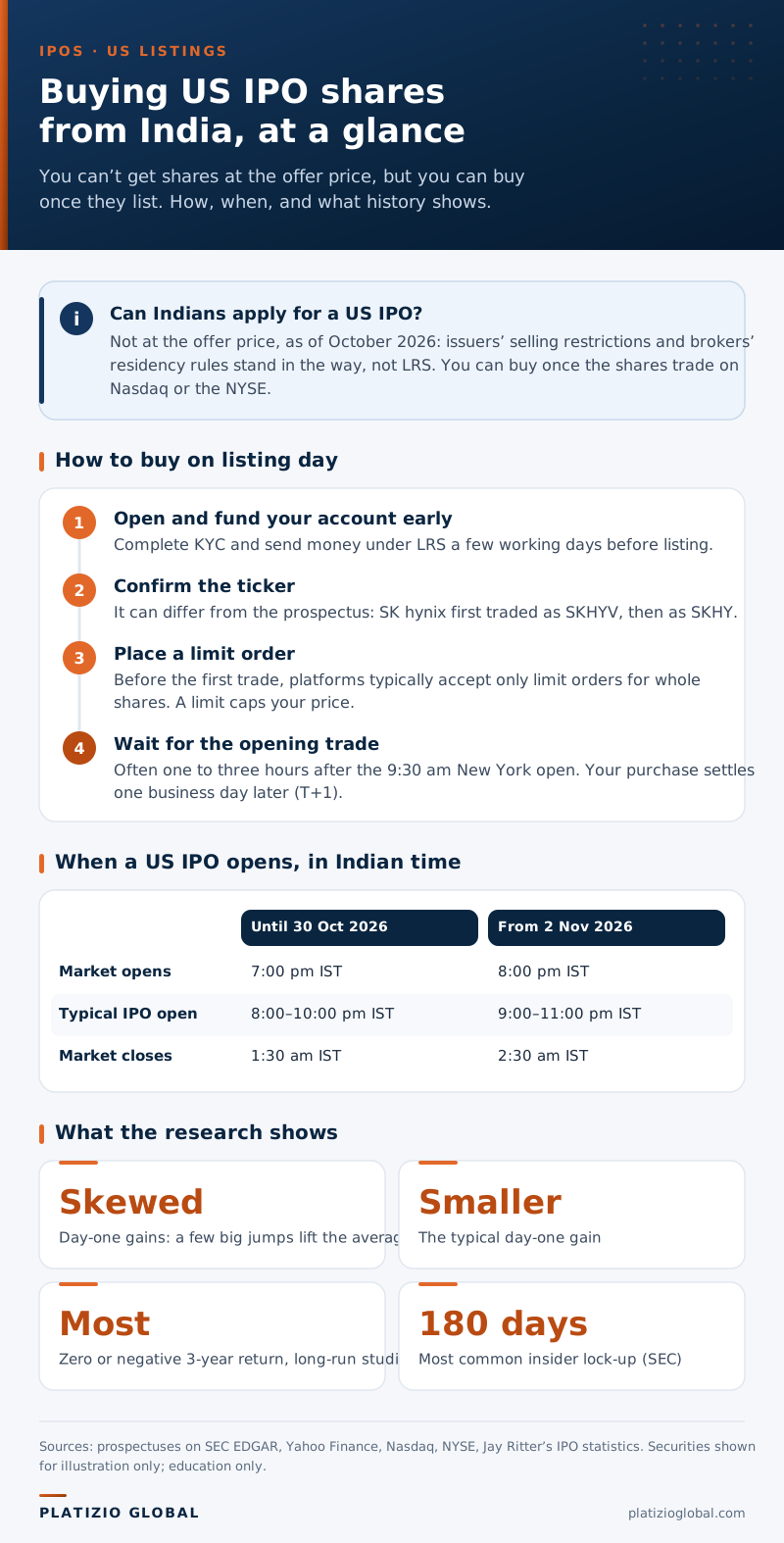
- High-demand IPOs have historically opened at 8:00–10:00 pm Indian time (IST); from 2 November 2026 that window is 9:00–11:00 pm IST.
Last updated: 15 October 2026 · By Analyst, Platizio Global
As of October 2026, resident Indians cannot get US IPO (initial public offering) shares at the offer price through any Indian or GIFT City platform. You can buy the shares once they start trading on Nasdaq or the New York Stock Exchange (NYSE), with money remitted under the Liberalised Remittance Scheme (LRS).
Can Indians apply for a US IPO?
Not at the offer price, as of October 2026. Underwriters allot US IPO shares at their discretion, mostly to institutions; retail investors get shares only through selected brokers (for SpaceX, Charles Schwab, Fidelity, Robinhood, SoFi and E*TRADE).
| Source | What it says |
|---|---|
| SpaceX final prospectus (Form 424B4), 11 June 2026 | Shares “have not been, and will not be, offered or sold to the public or any member of the public in India”, other than under private-placement exemptions |
| E*TRADE | IPO applicants must “Be a U.S. resident” |
| SoFi | Serves “eligible residents of the 50 U.S. states and Puerto Rico” |
| An overseas broker | SpaceX IPO access only for clients located and tax resident in the United Kingdom |
| A US broker used by several Indian apps | Buying the IPO directly is not available |
| A GIFT City app | Shares in a US IPO cannot be bought at the IPO price |
| Platizio Global FAQ | “Direct subscription to US IPOs is generally not available to retail investors” |
The barrier is not LRS, which permits overseas portfolio investment, but the issuer’s selling restrictions and the brokers’ residency rules.
How to invest in a US IPO from India
- Open and fund your account early. Complete KYC (know-your-customer checks) and send money under LRS a few working days before listing. How long funding takes depends on your bank and when you start the transfer; check your app’s funding page before listing day.
- Confirm the ticker on listing day. It can differ from the prospectus: SK hynix first traded as SKHYV, then as SKHY.
- Place a limit order for whole shares.
- Wait for the opening trade, often one to three hours after the 9:30 am New York open. Your purchase settles one business day later (T+1).
What time does a US IPO start trading in India?
A new listing stays halted at the 9:30 am New York open. On Nasdaq it opens through an auction, the IPO Halt Cross: 10 minutes of indicative prices, then a pre-launch period of no fixed length, until the lead underwriter says the stock is ready and price checks pass. On the NYSE, a designated market maker facilitates the opening auction, using the IPO price as its reference price.
| New York time | What happens | IST until 30 October 2026 | IST from 2 November 2026 |
|---|---|---|---|
| 9:30 am | Market opens; the new stock stays halted | 7:00 pm | 8:00 pm |
| 10:30 am–12:30 pm | Historical opening window for high-demand IPOs | 8:00–10:00 pm | 9:00–11:00 pm |
| 4:00 pm | Market closes | 1:30 am | 2:30 am |
IST times move an hour later from 2 November because US clocks go back on Sunday 1 November 2026. Recent first trades: Medline at 12:52 pm on 17 December 2025 (11:22 pm IST), SpaceX before noon on 12 June 2026 (before 9:30 pm IST) and SK hynix at 11:34 am on 10 July 2026 (9:04 pm IST).
Day-one rules: why a limit order matters
Before the first trade, platforms typically accept only limit orders for whole shares; some brokers reject market, fractional and dollar-amount orders until the opening auction is complete. A limit order also caps your price, which matters because the open can be far above the IPO price: Figma, priced at US$33, opened at $85. Also expect:
- Trading halts under Limit Up-Limit Down (LULD) rules when the price swings sharply; orders wait during a halt.
- No margin or short selling. Some brokers bar margin on new listings for 30 days, and LRS money cannot fund margin anyway.
- Regular hours only on day one at some platforms.
Not every platform publishes its IPO-day rules; check yours before listing.
How recent US IPOs traded
Large US IPOs in 2025 and 2026 opened well above their offer prices, and several later traded below where they first closed or even below the IPO price. A buyer on the exchange pays the opening price or later, not the IPO price, and a strong first day is not a guide to what comes next.
What research says about buying IPOs
Jay Ritter’s IPO statistics show:
- Long-run studies of US IPOs since 1980 find that the average first-day gain is driven by a few large jumps; the typical gain is much smaller, and about one in six closes below the offer price.
- Over the three years after the first-day close, IPOs have on average lagged the wider US market.
- Most IPOs in these studies had a zero or negative three-year return from the first-day close; a few big winners lifted the average.
Lock-ups: when insiders can sell
A lock-up stops insiders from selling for a set period, most often 180 days, according to the US Securities and Exchange Commission (SEC). The prospectus must disclose the terms, and the price may fall as a release nears. Some large IPOs stagger releases: SpaceX’s run from August 2026 to mid-2027, including releases due on 24 October and 8 December 2026. Find the dates under “Shares Eligible for Future Sale” in the final prospectus.
Where to read a US IPO prospectus
Every US IPO filing is free on the SEC’s EDGAR database:
- Form S-1 (US companies) or Form F-1 (foreign companies) registers the offer.
- S-1/A or F-1/A amendments add the price range or expected price.
- Form 424B4 is the final prospectus, filed after pricing.
Check who is selling shares (the company or existing holders), the lock-up schedule, country restrictions and risk factors. Nasdaq and the NYSE publish IPO calendars.
Is there an ETF for US IPOs?
The Renaissance IPO ETF, an NYSE Arca-listed exchange-traded fund (ticker IPO), tracks the Renaissance IPO Index, adding new IPOs each quarter and dropping them three years after listing; it charges 0.60% a year. On 14 October 2026 it held 54 stocks, including SpaceX (10.41%) and SK hynix (8.31%). It is an example, not a recommendation; check whether your platform offers it.
LRS, TCS and tax on newly listed US shares
Newly listed shares follow the same rules as any US share:
- LRS: up to $250,000 per financial year, with no margin trading.
- TCS (tax collected at source): 20% on the part of your total LRS remittances in a financial year above ₹10 lakh (section 394 of the Income-tax Act, 2025), claimed back in your return. Remitting ₹15 lakh in 2026-27 means TCS of 20% × (₹15,00,000 − ₹10,00,000) = ₹1,00,000.
- Capital gains: long-term only after more than 24 months, taxed at 12.5% without indexation (section 197), with no ₹1.25 lakh exemption; short-term at your slab rate.
- Dividends: taxed at your slab rate; the 25% US withholding (with a W-8BEN on file) is credited, up to the Indian tax on that income, under section 159 through Form 44 for tax year 2026-27, or Form 67 for FY 2025-26 income under the Income-tax Act, 1961.
- Disclosure: report the holding in Schedule FA, the foreign-assets schedule of your return.
More: tax on US stocks via GIFT City and platforms for US stocks.
Platizio Global (Platizio Services LLP) offers US-listed stocks and ETFs through accounts opened with ViewTrade International IFSC Private Limited (ViewTrade IFSC), regulated by IFSCA in GIFT City, but not IPO allotments.
Sources10
- SpaceX, final prospectus (Form 424B4), 11 June 2026 (SEC EDGAR)
- Federal Register, Nasdaq rule filing SR-NASDAQ-2025-011 on the IPO Halt Cross (Release 34-102413)
- SEC, Release 34-104856 on NYSE Rule 7.35A opening auctions (SR-NYSE-2026-08)
- Investor.gov (SEC), initial public offerings: lockup agreements
- Hapi (Apex-cleared US broker), SpaceX (SPCX) FAQ on IPO opening times
- Reserve Bank of India, Master Direction – Liberalised Remittance Scheme
- Income Tax Department, section 394 of the Income-tax Act, 2025 (TCS)
- E*TRADE from Morgan Stanley, new issues (IPO eligibility)
- Jay Ritter, IPO data (IPO statistics and long-run returns)
- Renaissance Capital, Renaissance IPO ETF
Platizio Global does not offer allotments in US IPOs. This article is for education only. It is not investment, tax or legal advice, or a recommendation to buy, sell or hold any security. The securities quoted are for illustration only and are not recommendatory. Investments in US stocks and ETFs are subject to market risk, currency risk and tax implications; past performance is not indicative of future results, and returns are not guaranteed. Prices, rules and tax rates are as of 15 October 2026 and can change; check them with a chartered accountant before you act. Platizio does not give investment advice and may receive referral fees or revenue share from ViewTrade.