Key takeaways
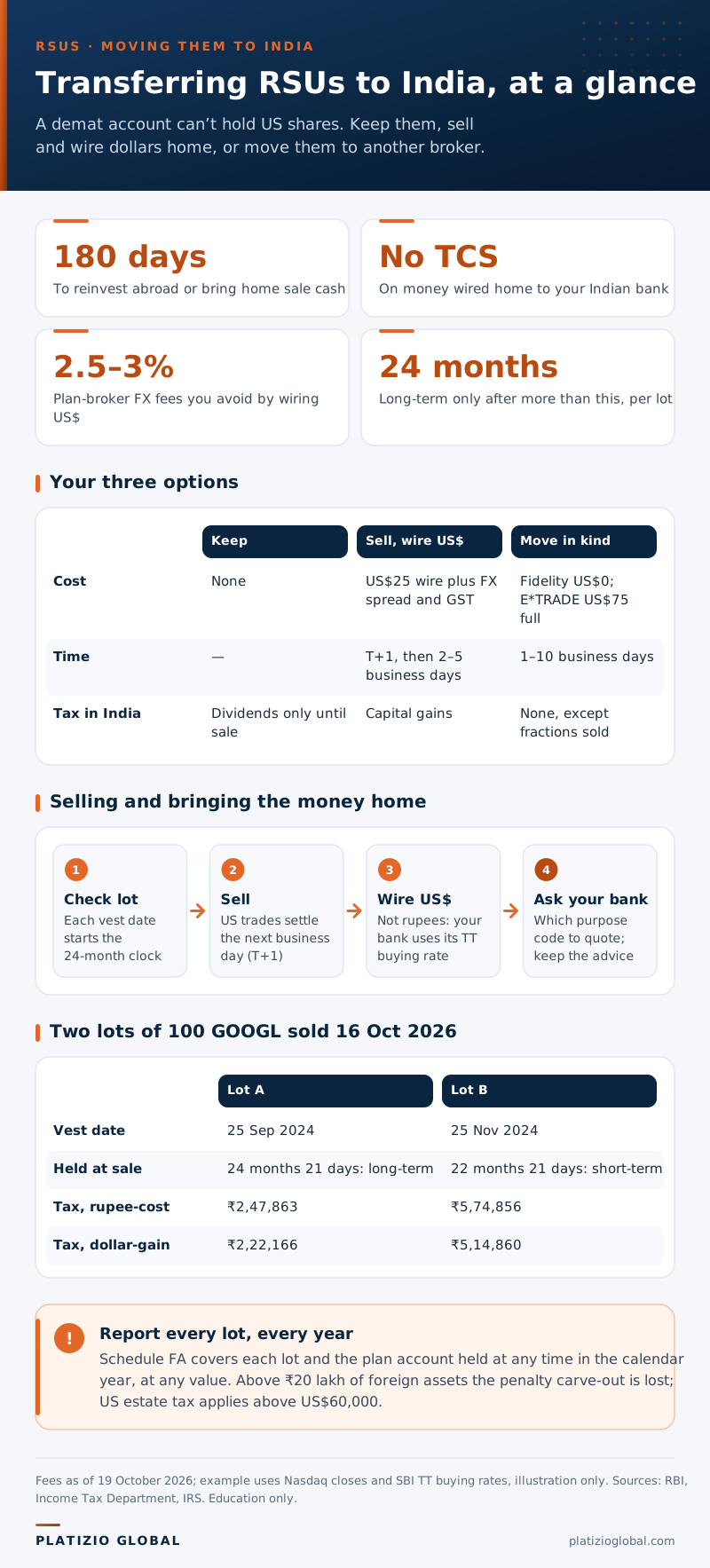
- TCS is collected on outward LRS remittances, not on money wired home; letting your Indian bank convert can avoid plan-broker FX fees of up to 2.5–3% (19 October 2026).
- Moving shares in kind is not taxed, except fractional shares sold on the way.
- Each vest lot is long-term only after more than 24 months (12.5% plus surcharge and cess; slab rate before); its cost is the value taxed at vest.
- Schedule FA covers the shares and plan account every calendar year; foreign assets above ₹20 lakh lose the Black Money Act penalty carve-out.
Last updated: 19 October 2026 · By Analyst, Platizio Global
You cannot move vested RSU (restricted stock unit) shares into an Indian demat account: US-listed shares are held at the US depository, the Depository Trust Company (DTC). In practice, “transferring RSUs to India” means selling and wiring dollars to an Indian bank, or moving the shares to a broker serving Indian residents; you can also keep them. Dollars left abroad must be reinvested or brought home within 180 days.
FEMA rules: holding, LRS and 180 days
Holding. FEMA, India’s foreign-exchange law, lets employees of a foreign company’s Indian office, branch or subsidiary “acquire, without limit,” shares under an employee stock ownership plan (ESOP) or benefit scheme, such as RSUs, offered globally on a uniform basis (Overseas Investment Rules, 2022, Schedule III). RBI’s Overseas Investment Master Direction (updated 1 April 2026, para 1(ix)(f)) classes such holdings, up to 10% and without control, as overseas portfolio investment (OPI).
LRS limit: unsettled. The Liberalised Remittance Scheme (LRS) caps remittances at US$250,000 a financial year. Master Direction para 22(7) says ESOP and Employee Benefits Scheme “remittances shall be reckoned towards the LRS limit”, but RSUs usually involve no remittance, which it does not address. Nishith Desai Associates reads the shares’ value as counting; LKS says such acquisitions sit outside LRS ceilings. Ask your bank before large LRS remittances in a vesting year.
180 days for cash. Sale proceeds and dividends must be reinvested abroad, or surrendered to an authorised person (a bank), within 180 days of receipt (FEMA 9(R)/2015-RB, Regulation 7; Master Direction para 1(ix)(c); LRS Master Direction para 17). RBI does not define “reinvested” or say whether the clock starts at trade or settlement. Your employer, not you, files Form OPI (para 22(5)) and may ask for your data.
Your options compared
| Option | Cost (published fees, 19 Oct 2026; stock-plan accounts may differ) | Time | Tax in India |
|---|---|---|---|
| Keep at the plan broker | None | — | Dividends only until sale |
| Sell, wire US$ to an Indian bank | US$25 wire (E*TRADE, Schwab; US$15 online at Schwab) plus FX spread and GST: about 0.63% of US$20,000 (16 Oct rates) | T+1, then 2–5 business days (Investmates) | Capital gains |
| Move shares in kind | Sending: Fidelity US$0; Schwab US$0 partial, US$50 full; E*TRADE US$75 full. Receiving: often US$0 at the receiving broker | About 1–10 business days | None, except fractions sold |
How to sell RSUs and repatriate the money to India
- Check each lot’s vest date (it starts the 24-month clock), then sell; US trades settle the next business day (T+1).
- Wire US dollars, not rupees. Plan brokers charge up to 2.50% (E*TRADE; US$500 on US$20,000) or 3% (Schwab, Fidelity) to convert; your Indian bank uses its telegraphic transfer (TT) buying rate.
- Ask your bank which purpose code to quote for repatriating overseas portfolio investment (here, RSU sale proceeds) and which documents it needs. Keep its inward remittance advice.
Cost on 16 October 2026. A US$20,000 E*TRADE wire nets US$19,975 after its US$25 fee. Your Indian bank then converts it at its buying rate, which for SBI that day was 0.45% below its card mid-point, and charges GST on the conversion: 18% of ₹5,500 plus 0.1% of the excess over ₹10 lakh (CGST rule 32(2)(b)). Together that came to about 0.63% less than converting US$20,000 at the mid-point. Intermediary and inward fees are extra.
How to move RSUs from E*TRADE or Schwab to another broker
- Open a receiving account that accepts Indian residents and incoming transfers.
- Ask which route applies: ACATS (the US account-transfer system), a DTC delivery or, for shares held with a transfer agent, DRS (Direct Registration System).
- Only whole, vested shares move; fractions are sold, a taxable sale.
- Keep your own cost records. A receiving broker may not carry your cost basis across automatically; your Indian cost, the rupee value taxed at vest, never comes from a US broker.
GIFT City is unconfirmed for RSU money. ICICI Bank’s GIFT City unit lifts LRS limits on money from abroad only if it is earlier LRS money or income on it. Confirm in writing first.
How RSUs are taxed in India
- At vest: the shares’ value on the vest date is salary (section 17(2)(vi) of the 1961 Act; section 17(1)(d) of the 2025 Act); your employer deducts TDS, sometimes by selling shares (“sell-to-cover”).
- At sale: the holding period runs from each vest date (section 2(101), Income-tax Act, 2025). Gains after more than 24 months are taxed at 12.5% without indexation (section 197) plus surcharge and 4% cess, with no ₹1.25 lakh exemption; earlier gains at slab rates (RSU taxation explained).
- Cost and rate: cost is the value taxed at vest (old section 49(2AA)); Rule 206 of the Income-tax Rules, 2026 converts the sale at SBI’s TT buying rate for the previous month’s last day, without saying whether to convert the dollar gain instead.
- Dividends: 25% US withholding with a valid Form W-8BEN (the IRS treaty form), 30% without. India taxes the gross dividend at slab rates and allows credit for the US tax, if claimed, up to the Indian tax (Form 67 for FY 2025-26 income, then Form 44; foreign tax credit guide). The credit is not automatic, and any excess US tax is generally not refunded.
Worked example: two lots of 100 Alphabet (GOOGL) shares
For illustration only: Nasdaq closes at vest, SBI TT buying rates, tax at 31.2% (30% slab plus 4% cess) or 13% long-term, no surcharge or fees. Each lot sells on 16 October 2026 at US$340.59, converted at the 30 September 2026 rate: US$34,059 × ₹95.42 = ₹32,49,910.
| Lot A | Lot B | |
|---|---|---|
| Vest date; cost (value at vest) | 25 Sep 2024: 100 × US$161.49 × ₹83.18 = ₹13,43,274 | 25 Nov 2024: 100 × US$167.65 × ₹83.95 = ₹14,07,422 |
| Held at sale | 24 months 21 days: long-term | 22 months 21 days: short-term |
| Rupee-cost method: gain; tax | ₹19,06,636; ₹2,47,863 | ₹18,42,488; ₹5,74,856 |
| Dollar-gain method: gain; tax | US$17,910 × ₹95.42 = ₹17,08,972; ₹2,22,166 | US$17,294 × ₹95.42 = ₹16,50,193; ₹5,14,860 |
The rupee-cost method also taxes the rupee’s fall since vest (₹1,97,664 more gain on Lot A); agree a method with your chartered accountant (CA). Lot B misses the 24-month line: taxed as long-term, it would owe ₹2,39,523, or ₹3,35,333 less. Any sale after 25 November 2026 would be long-term (ask your CA whether 25 November itself counts), but waiting carries market, currency and single-stock risk.
Schedule FA and US estate tax
- Schedule FA (foreign assets in your return): report each lot (Table A3) and the plan account (Table A2) held at any time in the calendar year, at any value, including shares sold or sold-to-cover.
- Black Money Act: since 1 October 2024 the ₹10 lakh penalty for omitting a foreign asset (section 43) does not apply if foreign assets other than immovable property total ₹20 lakh or less. Lot A alone peaked at ₹28,67,296 on 25 November 2025 (100 × US$323.44 × ₹88.65), well above it (Schedule FA penalties explained).
- US side: the US generally does not tax capital gains on US shares of a non-resident alien who is present in the US for fewer than 183 days in the tax year, subject to exceptions, and India taxes the gain. US-listed shares are also US-situs assets for estate tax: above US$60,000 at death, Form 706-NA is due, with a US$13,000 credit and rates up to 40%. 200 GOOGL shares (US$68,118 on 16 October 2026) would owe US$2,110.68 (US estate tax guide).
Sources12
- Reserve Bank of India: Master Direction – Overseas Investment (FED MD No. 15/2024-25, updated 1 April 2026) — https://rbi.org.in/SCRIPTS/BS_ViewMasDirections.aspx?id=12710
- Reserve Bank of India: Notification No. FEMA 9(R)/2015-RB on realisation, repatriation and surrender of foreign exchange (29 December 2015) — https://www.rbi.org.in/Scripts/NotificationUser.aspx?Id=10258&Mode=0
- Reserve Bank of India: Master Direction – Liberalised Remittance Scheme (updated 6 September 2024) — https://www.rbi.org.in/Scripts/BS_ViewMasDirections.aspx?id=10192
- Government of India: Foreign Exchange Management (Overseas Investment) Rules, 2022 (G.S.R. 646(E), 22 August 2022; Income Tax Department copy) — https://incometaxindia.gov.in/Documents/Provisions%20for%20NR/FEM-Overseas-Investment-Rules-2022.htm
- Income Tax Department: section 2 of the Income-tax Act, 2025 (definitions) — https://www.incometaxindia.gov.in/w/section-2-263
- Income Tax Department: section 197 of the Income-tax Act, 2025 — https://www.incometaxindia.gov.in/w/section-197-78
- Income Tax Department: section 49 of the Income-tax Act, 1961 — https://www.incometaxindia.gov.in/w/section-49
- Income Tax Department: Rule 206 of the Income-tax Rules, 2026 — https://www.incometaxindia.gov.in/w/rule-206-1
- India Code: Black Money (Undisclosed Foreign Income and Assets) and Imposition of Tax Act, 2015 — https://www.indiacode.nic.in/bitstream/123456789/2147/1/A201522.pdf
- IRS: Instructions for Form 706-NA (Rev. 09/2025) — https://www.irs.gov/instructions/i706na
- IRS: Publication 519, US Tax Guide for Aliens — https://www.irs.gov/publications/p519
- State Bank of India: daily forex card rates (USD TT buying and selling), as archived by sbi-fx-ratekeeper — https://github.com/sahilgupta/sbi-fx-ratekeeper
This article is for education only. It is not investment, tax or legal advice, or a recommendation to buy, sell or hold any security. The securities quoted are for illustration only and are not recommendatory. Moving or selling RSU shares has FEMA, tax and reporting consequences that depend on your facts. Investments in US stocks and ETFs are subject to market risk, currency risk and tax implications; past performance is not indicative of future results, and returns are not guaranteed. Prices, fees, tax rates and rules are as of 19 October 2026 and can change; check them with a chartered accountant before you act.