Key takeaways
- Nasdaq adopted a fast-entry rule in 2026 that can add a large new listing to the index within weeks; check a fund’s current holdings rather than assuming any company is in it.
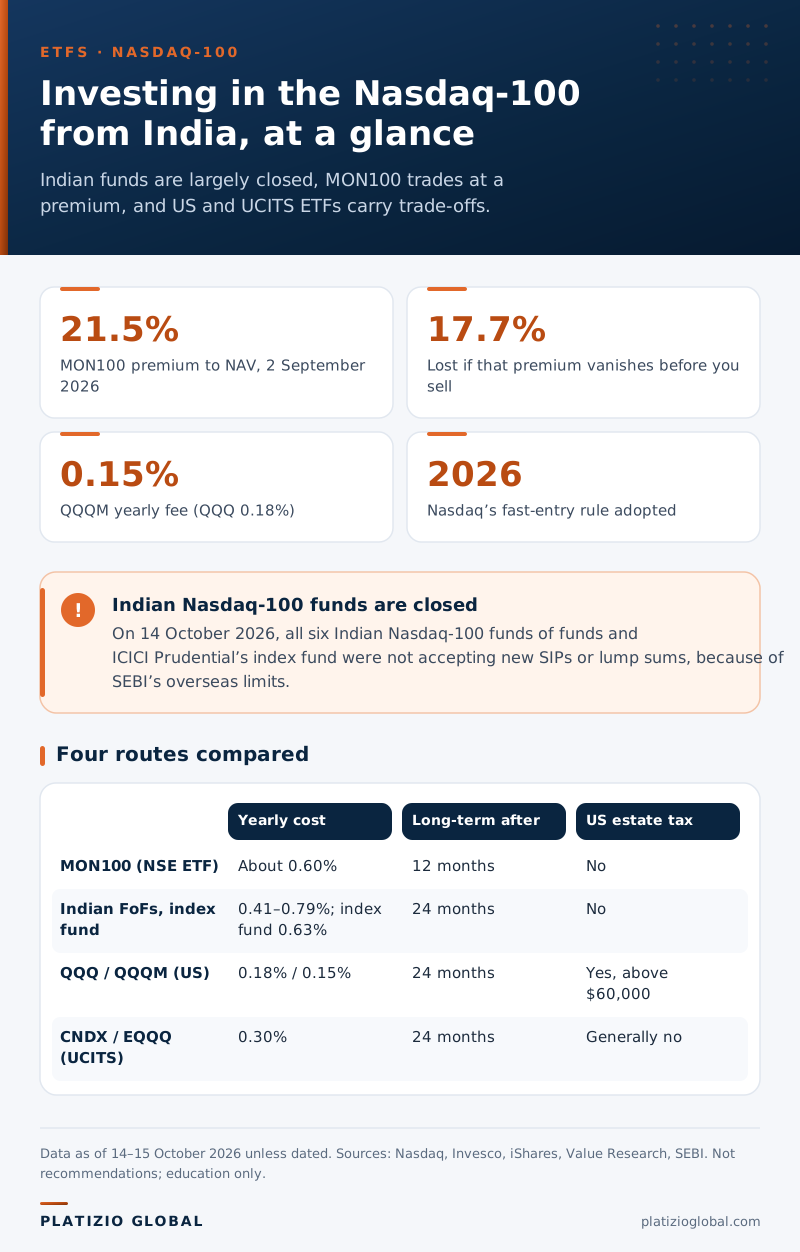
- On 14 October 2026, all six Indian Nasdaq-100 funds of funds and ICICI Prudential’s index fund were not accepting new SIPs or lump sums.
- Buying MON100 at its 21.5% premium of 2 September 2026 loses about 17.7% of the amount invested if the premium vanishes before you sell.
- As of October 2026, QQQM (0.15% a year) and QQQ (0.18%) cost less than the Irish CNDX and EQQQ (0.30%), but carry US estate tax exposure above US$60,000.
- In tax year 2026-27, MON100 turns long-term after 12 months and the other routes after 24 months; long-term gains are taxed at 12.5%.
Last updated: 15 October 2026 · By Analyst, Platizio Global
You can invest in the Nasdaq-100 from India through Indian funds, US-listed ETFs (QQQ, QQQM) or Irish UCITS ETFs (CNDX). As of October 2026, Indian Nasdaq-100 mutual funds are closed to new systematic investment plans (SIPs) and lump sums, and the NSE-listed MON100 ETF traded 21.5% above its net asset value (NAV) on 2 September 2026.
What is the Nasdaq-100, and what changed in 2026?
The Nasdaq-100 measures 100 of the largest non-financial companies listed on Nasdaq, weighted by market capitalisation with caps on the largest weights. It is reconstituted each December and rebalanced quarterly.
Nasdaq changed the rules in 2026:
- Fast entry, from 1 May 2026: a new listing that ranks in the top 40 can join after 15 trading days. A Nasdaq.com article of 29 June 2026 said SpaceX was set to be among the first listings to use it.
- From the 22 June 2026 quarterly review: companies with a free float (freely traded shares) of 33.3% or less are weighted at up to three times their float; the 10% minimum float was dropped; companies ranked outside the top 125 are removed each quarter, replacing the “10 basis point rule”; and rankings use total listed and unlisted shares.
The largest weights in Invesco’s QQQ on 13 October 2026, per stockanalysis.com, were NVIDIA (8.30%), Apple (7.50%), Microsoft (6.08%), Alphabet (6.04% across two share classes), Micron (4.48%), Amazon (4.20%), AMD (4.11%) and Meta (3.42%). These are fund weights, not official index weights.
How to invest in the Nasdaq-100 from India: three routes
Route 1: Indian Nasdaq-100 funds and the MON100 ETF
New rupee money is largely shut out. On 14 October 2026, the funds’ scheme pages showed new SIPs and lump sums as not allowed in the Nasdaq-100 funds of funds (FoFs, which invest in other funds) from Motilal Oswal, Kotak, Navi, Aditya Birla Sun Life, Axis and Invesco, and in the ICICI Prudential NASDAQ 100 Index Fund. Motilal Oswal stopped new SIP registrations in its FoF from 10 December 2024; existing SIPs continue and redemptions are allowed. The cause is SEBI’s overseas limits for mutual funds: $7 billion across the industry, plus a separate $1 billion for overseas ETFs.
That leaves the Motilal Oswal NASDAQ 100 ETF (MON100) on the NSE, with an expense ratio of about 0.60% (sharpely, 14 October 2026). The same limits stop new units being created, so its price can drift far above NAV. On 2 September 2026, MON100’s NAV was ₹270.56 but it traded at ₹328.83, a 21.5% premium; over the previous year the premium averaged 10.8% and ranged from −3.0% to 27.7% (Value Research). Mirae Asset has warned that a price-band rule effective 7 September 2026 can let such premiums widen, and advises comparing the price with the iNAV (an intraday estimate of NAV) before buying.
Route 2: US-listed QQQ or QQQM
As of October 2026, Invesco’s QQQM charges 0.15% a year and QQQ 0.18%, after QQQ’s shareholders approved converting it from a unit investment trust to an open-end fund in December 2025. You buy them in dollars under the Liberalised Remittance Scheme (LRS), through a Global Access app in GIFT City (India’s International Financial Services Centre) or an overseas broker; compare them in our platforms guide.
The trade-offs: dividends (QQQ’s trailing yield was 0.42% in October 2026) suffer 25% US withholding (30% without Form W-8BEN). Tax collected at source (TCS) under section 394 is 20% on LRS remittances beyond the first ₹10 lakh in a financial year, adjustable against your tax. And US-listed ETF shares are generally US-situated (treated as US property), so US estate tax can apply above $60,000, even when a GIFT City broker holds them in its omnibus account.
Route 3: Nasdaq-100 UCITS ETFs (CNDX, EQQQ)
UCITS ETFs are EU-authorised funds; the main Nasdaq-100 versions are Irish-domiciled and listed in London. The iShares NASDAQ 100 UCITS ETF (CNDX, accumulating) and the Invesco EQQQ NASDAQ-100 UCITS ETF (EQQQ, distributing; its accumulating class, EQAC, is not listed in London) each cost 0.30% a year (August–October 2026 data). You can buy them under LRS through a GIFT City app that lists them, or an overseas broker.
Irish fund shares are generally outside US estate tax, and US dividends are taxed at 15% inside the fund. At a 0.42% yield, that saves only about 0.04 percentage point a year against a US ETF, less than CNDX’s extra 0.15 point in fees over QQQM. See UCITS ETFs vs US-listed ETFs.
Nasdaq-100 routes compared
| MON100 (NSE ETF) | Indian FoFs and index fund | QQQ / QQQM (US-listed) | CNDX / EQQQ (Irish UCITS) | |
|---|---|---|---|---|
| Yearly cost | About 0.60% | 0.41–0.79% including underlying fund; index fund 0.63% | 0.18% / 0.15% | 0.30% |
| Minimum | 1 unit (about ₹329 on 2 September 2026) | Closed to new money | Fractional on many apps | Fractional on some apps |
| SIP | No fund SIP; exchange purchases | New SIPs closed | Recurring buys if your platform offers them | Same as US-listed |
| LRS and TCS | No | No | Yes; 20% TCS above ₹10 lakh | Yes; same |
| Tax: long-term (12.5%) after | 12 months | 24 months | 24 months | 24 months |
| Currency | Rupees | Rupees | US dollars | US dollars or pounds |
| US estate tax | No (Indian fund units) | No (Indian fund units) | Yes, above $60,000 | Generally no |
| Schedule FA | No | No | Yes | Yes |
| Liquidity | ₹23.26 crore a day on average (2 September 2026 data) | Redeem at NAV | QQQ assets $507.7 billion | CNDX fund assets $31.3 billion |
Data as of 14–15 October 2026 unless dated; EQQQ’s fee per justETF, 31 August 2026. Illustrative, not recommendations.
How is each route taxed in tax year 2026-27?
In tax year 2026-27, the first under the Income-tax Act, 2025, long-term capital gains (LTCG) are taxed at 12.5% on every route and short-term gains at your slab rate. The holding period and dividends differ:
- MON100, an India-listed international ETF, turns long-term after 12 months. The ₹1.25 lakh LTCG exemption does not apply, because it is not an equity-oriented fund.
- Nasdaq-100 FoFs and the ICICI index fund turn long-term after 24 months. If you bought units between 1 April 2023 and 31 March 2025, confirm their treatment with a chartered accountant (CA).
- QQQ, QQQM, CNDX and EQQQ are foreign assets: long-term after 24 months, taxed under section 197. QQQ and QQQM dividends and EQQQ distributions are taxed at your slab rate; CNDX and EQAC pay nothing out, so tax is generally deferred until sale. Credit for the 25% US tax on QQQ and QQQM dividends is claimed on Form 44; the 15% paid inside an Irish fund generally cannot be claimed. Report these ETFs every calendar year in Schedule FA, the foreign-assets schedule of your tax return.
Income from FY 2025-26 is still reported under the 1961 Act, where the credit form is Form 67.
Worked example: what a 21.5% premium can cost
At a 21.5% premium, ₹10,00,000 buys only ₹8,23,045 of MON100’s underlying value (₹10,00,000 ÷ 1.215). If the premium has gone when you sell, that 17.7% is lost whatever the index does.
Over a long holding, the fund’s fee, any premium you pay or lose, tax on dividends and the rupee all change what you end up with; we do not project returns.
For reference: accounts opened through Platizio Global are held with ViewTrade International IFSC Private Limited (ViewTrade IFSC), regulated by the International Financial Services Centres Authority in GIFT City. Its brokerage on US-listed shares and ETFs is 0.29% per transaction (or US$1 minimum) plus 18% IGST, as of October 2026. This is information, not a recommendation to buy any fund.
Sources11
- Nasdaq — Nasdaq-100 Index methodology — https://indexes.nasdaqomx.com/docs/Methodology_NDX.pdf
- Nasdaq — 2026 NDX methodology changes FAQ — https://indexes.nasdaqomx.com/docs/2026_NDX_Changes_FAQ.pdf
- Nasdaq.com — SpaceX set for rapid entry into the Nasdaq-100 (29 June 2026) — https://www.nasdaq.com/articles/spacex-set-rapid-entry-nasdaq-100-etfs-focus
- Motilal Oswal Mutual Fund — Addendum discontinuing new SIP registrations (5 December 2024) — https://www.motilaloswalmf.com/content/dam/motilal-mf/downloads/mf/addendums/2024/dec/f2e8a-addendum-final.pdf
- IRS — Instructions for Form 706-NA (Rev. 09/2025) — https://www.irs.gov/instructions/i706na
- Income Tax Department — Section 2, Income-tax Act, 2025 (holding periods) — https://www.incometaxindia.gov.in/w/section-2-263
- CBDT — FAQs on Form 44 and Form 45 — https://www.incometaxindia.gov.in/documents/d/guest/form-44-45-faqs
- ICICI Prudential AMC — Tax Reckoner 2026-27 — https://www.icicipruamc.com/blob/knowledgecentre/tax_reckoner/Tax%20Reckoner%202026-27.pdf
- iShares — iShares NASDAQ 100 UCITS ETF (CNDX) — https://www.ishares.com/uk/individual/en/products/253741/ishares-nasdaq-100-ucits-etf
- Value Research — International funds open for investment, September 2026 — https://www.valueresearchonline.com/stories/229558/international-funds-open-for-investment-september-2026/
- stockanalysis.com — Invesco QQQ (fees, yield and holdings) — https://stockanalysis.com/etf/qqq/
Accounts opened through Platizio Global are held with ViewTrade International IFSC Private Limited (ViewTrade IFSC), regulated by the International Financial Services Centres Authority in GIFT City (broker-dealer IFSC/BD/2024-25/0003; Global Access Provider IFSCA/GAP/BD/2025-26/001). Platizio Services LLP operates Platizio Global as a white-labelled partner platform in association with ViewTrade. Platizio is not a broker, broker-dealer, custodian, investment adviser, portfolio manager, research analyst, or authorised dealer. Platizio does not hold securities or client money and does not provide custody services. Platizio may receive referral fees or revenue share from ViewTrade. Platizio does not give investment advice. Platizio Global offers US-listed stocks and ETFs only; it does not offer UCITS ETFs or other securities listed outside the US. This article is for education only and is not investment, tax or legal advice, or a recommendation to buy, sell or hold any security. The securities quoted are for illustration only and are not recommendatory. Investments in US stocks and ETFs are subject to market, currency, tax and regulatory risks; past performance is not indicative of future results, and returns are not guaranteed. Tax and regulatory figures are current as of 15 October 2026 and can change; consult a chartered accountant before acting.